

About ten years ago, the trend was to share HR functions with managers.
This decentralization was intended to enable greater responsiveness and serve as a means of diversifying managers' tasksand thus motivating them. This trend was accelerated by the requirement forprofessional interviewsintroduced by law in 2003.
You only need to look at training organization catalogs to see the impact this HR reorganization has had on the role of managers. Alongside traditional management topics such as "knowing how to organize and manage activities," "knowing how to delegate," and "knowing how to communicate," there are HR training courses such as "successful professional interviews, " of course, but also "knowing how to recruit," "managing psychosocial risks," "knowing how to discuss with staff representatives," etc.
In recent years, we have seen an increasing number of training courses on change management and leadership development. leadership development. And rightly so, because today's managers must become leaders who inspire and support their teams through change.
Except that, in the end, we are certainly askingtoo much of managers. To illustrate this point, one of the heavyweights in inter-company training offers 77 training courses for managers!
However, despite this abundance of training courses, it seems to us that one topic has not been sufficiently addressed: training managers in compensation or, more specifically, in the use of compensation in their managerial activities.
When companies decentralized HR, they delegated certain functions to managers, such as schedule and leave management, recruitment, and, of course, performance reviews. However, they generally retained responsibility for relations with social partners, legal matters, and, of course, compensation policy. This seems justified, as it is a sensitive, technical, and legal issue that requires expertise, given that payroll often accounts for 70% to 80% of a company's added value.
Except that, whether we like it or not, a manager will always be the company's first point of contact for HR matters. They are on the front line and must be highly responsive in dealing with critical day-to-day situations, particularly those relating to compensation. Failure to do so will result in disengagement and demotivation among their teams, with more or less immediate consequences for performance.
In conclusion, managers who lead change and transformation must give meaning to the company's projects and policies. This also applies to compensation policy, which is why it is in the company's best interest to provide them with better training on this topic.
Another article that may interest you: Manager Training, what else?
If compensation is a topic that interests you, we invite you to check out our selection of white papers...
Impact of transparency on sales staff compensation
Remuneration transparency – Aligning compliance and strategy for 2027
Sales rep compensation – a performance booster!
Pay equity: Towards a fair and impactful wage policy
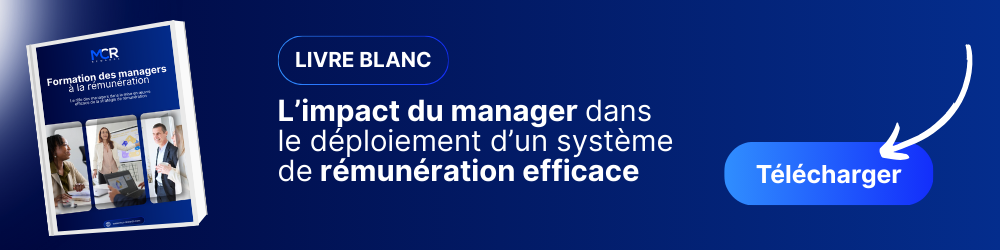
The impact of managers in implementing an effective compensation system
Contact us for more information: mcr@mcr-consultants.com
Follow us on YouTube and LinkedIn
For more information: MCR Group | MCR Rewards | MCR Selling
