
Impact of the increase in the minimum wage and legal minimums

The Essentials
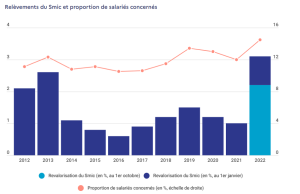
The minimum wage rose by 9.95% between January 2021 and January 2023, compared with just 2.73% over the two years preceding the health crisis. It was adjusted twice in 2021 and three times in 2022—an unprecedented occurrence over the past ten years. Approximately 2.5 million employees (15% of the total) are paid the minimum wage. As a direct result, the budget for wage increases is primarily absorbed by meeting the minimum wage requirements set by collective bargaining agreements, reducing employers’ ability to reward their most deserving employees.
The start of the year is an opportunity for HR departments to "reset their clocks" by catching up on certain developments and trends for the coming months. 2023 began with an increase in the minimum wage(1) to €1,709.28 per month for a 35-hour working week, excluding special cases (Mayotte).
The last few years have been very turbulent in terms of social regulations. Especially since the health crisis and the return of inflation...
The change in the minimum wage over the last two years is a perfect illustration of this:+9.95% (from January1, 2021, to January1, 2023, compared to a change of +2.73% over the two years preceding the health crisis (from January1, 2018, to January1, 2020).
Given the context, the minimum wage has been increased twice in 2021 and three times in 2022! This has never happened in the last 10 years.
The minimum wage is adjusted to take inflation into account whenever the consumer price index varies by at least 2%.
These two factors have a direct impact on decisions regarding salary increases and on the minimum wages set by collective agreements(2), which are binding on employers. The latter are therefore influenced, particularly in cases where the minimum wage exceeds them. This is the case, for example, for companies covered by the collective agreement for hotels, cafés, and restaurants (at Level 1).
So, does the increase in the minimum wage make it more difficult to allocate a larger budget to the most deserving employees?
Consequence for the employer: the increase budget is mainly absorbed by compliance with minimum wage agreements and the minimum wage.
With approximately 2.5 million employees paid the minimum wage(15% of all employees), these factors are important to consider when preparing and allocating budget increases (3).
First, it is important to consider what is included in the basis for the minimum wage under the collective agreement. This must be defined in the collective agreement or contract in force.
In practice, remuneration must be at least equal to the minimum wage each month, unless otherwise specified in the collective agreement.
The factors to be taken into account when verifying compliance with the minimum wage are set out in the collective agreement. If these are not specified, then factors directly related to the employee's professional activity should be included (4).
(5) Remuneration consisting of a fixed salary and a percentage of turnover should also be included.
Finally, all these measures have an impact on companies' internal salary scales, which are often constructed taking into account the legal minimum and the minimums resulting from collective agreements.
Should we focus on increasing the base salary or work on structuring the compensation package?
Depending on company practice, the link may, for example, be based on the following remuneration, as recalled in case law:
- A collective bonus (3);
- A performance bonus (4);
- A monthly target bonus (5);
- Commissions paid to an employee (6).
(1)"As a reminder, the minimum wage (SMIC) is the hourly wage below which employers cannot pay their employees, regardless of the form of remuneration (hourly, performance-based, piecework, commission, or tips). It ensures that employees with the lowest wages have guaranteed purchasing power and can participate in the nation's economic development.
https://travail-emploi.gouv.fr/droit-du-travail/la-remuneration/article/le-smic "
(2) The minimum wage is a minimum wage rate corresponding to the classification of the employee concerned in the pay scale of the collective agreement (Labor Code, Art. L. 2254-1).
(3)https://dares.travail-emploi.gouv.fr/publication/la-revalorisation-du-smic-au-1er-janvier-2022.
(4) Court of Cassation, Social Chamber Public hearing on Wednesday, June 8, 1994. Appeal No.: 91-41166 Not published in the bulletin
(5) Court of Cassation, December 15, 1982, appeal no. 80-41008
(6) Social Chamber, June 1, 1983, No. 80-41666
(7) Cass. Soc., November 8, 1983, No. 81-41538
(8) Cass. Soc., June 4, 2002, No. 00-41140
(9) Cass. Soc., April 2, 2003, No. 01-40338
Read also: Wage increases and inflation: a delicate balancing act
Frequently Asked Questions
How is the minimum wage adjusted, and based on what criteria?
The minimum wage is automatically adjusted whenever the consumer price index changes by at least 2%, taking inflation into account. This mechanism has led to exceptionally frequent adjustments in recent years: twice in 2021 and three times in 2022—an unprecedented occurrence over the previous decade. As of January 1, 2023, it stood at 1,709.28 euros gross per month based on a 35-hour workweek.
What impact do increases in the minimum wage have on companies’ budgets for salary increases?
When the minimum wage increases, it may exceed certain contractual minimums, forcing employers to raise the lowest wages to remain compliant. The budget for raises is then primarily absorbed by meeting these minimums, automatically reducing the company’s ability to reward its most deserving employees with individual raises. This has the effect of compressing internal pay scales, a phenomenon that is particularly noticeable in sectors such as the hospitality and restaurant industry.
What is the contractual minimum wage, and how does it differ from the SMIC?
The contractual minimum is the minimum wage rate defined by the collective bargaining agreement applicable to the company, corresponding to the employee’s classification on the pay scale. It is binding on the employer regardless of the SMIC, and the compensation paid must be at least equal to this minimum each month. When the SMIC exceeds the contractual minimum, the SMIC applies, which may force industries to renegotiate their pay scales.
Which components of compensation can be taken into account when verifying compliance with the minimum wage under the collective bargaining agreement?
The factors to be taken into account are defined by the applicable collective bargaining agreement. In the absence of specific provisions in the agreement, case law identifies factors directly related to the performance of professional duties: collective bonuses, performance bonuses, monthly goal bonuses, sales commissions, or compensation consisting of a fixed amount and a percentage of revenue. Each situation must be analyzed in light of the applicable collective bargaining agreement.
Should we raise the base salary or revise the compensation package in light of pressure from the minimum wage?
The two approaches are not mutually exclusive. Increasing the base salary ensures regulatory compliance and improves the employee’s guaranteed compensation, but it entails an ongoing cost for the company. By refining the compensation package—including bonuses, profit-sharing, and non-monetary benefits—companies can maintain their ability to attract and retain top talent while keeping the overall budget under control.
How can a company anticipate the impact of minimum wage increases on its internal pay scale?
A pay scale designed in accordance with statutory and collective bargaining minimums must be revised as soon as an increase in the minimum wage (SMIC) or industry-specific minimums is announced. This revision must anticipate the effects of compression between classification levels to prevent entire pay grades from being squeezed. MCR Groupe assists companies in developing and updating robust pay scales capable of absorbing these changes without losing their internal consistency.
Want to go further? Discover all our C&B solutionsour compensation solutions andour C&B solutions
If compensation is a topic that interests you, we invite you to check out our selection of white papers...
Impact of transparency on sales staff compensation
Remuneration transparency – Aligning compliance and strategy for 2027
Sales rep compensation – a performance booster!
Pay equity: Towards a fair and impactful wage policy
The impact of managers in implementing an effective compensation system
Contact us for more information: mcr@mcr-consultants.com
Follow us on YouTube and LinkedIn
For more information: MCR Group | MCR Rewards | MCR Selling

- Published in:
- C&B
- Tagged:
- legal minimums, minimum wage